Subsidiary Company vs Branch Office For Foreign Businesses In Malaysia
For foreign businesses who want to operate in Malaysia, the two most viable structures are a locally incorporated subsidiary or branch office, both of which are registered with the Companies Commission of Malaysia (SSM) under the Companies Act 2016.
As both structures are capable of hiring, securing premises, and applying for licenses (subject to sector-specific regulations), the choice ultimately depends on the foreign business’s risk appetite and preferred level of control. To this end, subsidiaries are the more common choice (and our recommendation) but branch offices have their use cases.
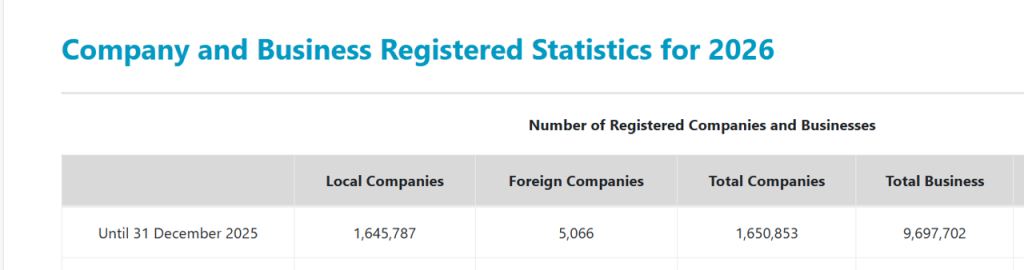
Subsidiaries are local companies and outnumber foreign companies by quite a bit.
This guide helps readers decide which is the better choice for them, and here’s how we’ve broken it down:
- a brief description of each with real-life examples
- a quick comparison table
- real-life examples of each, and
- our professional thoughts on which you should choose
Let’s begin.
Subsidiary company
A subsidiary is a private limited company incorporated in Malaysia in which a foreign parent company holds majority shareholding or control over director appointments and voting rights. It is recognised as a separate legal entity under the Companies Act 2016, meaning it can conduct business in its own name. As a local resident company, it is subject to a 24% flat corporate tax rate which can be reduced if partnering with a local.
Importantly, the parent company is generally not liable for the subsidiary’s debts beyond its capital investment.
Minimum requirements
- one shareholder
- one resident director in Malaysia
- RM2,500 paid-up capital (statutorily RM1 is enough, but RM2,500 is commonly required by banks to open a corporate account)
- RM1,010 SSM registration fee
- appointment of a registered Company Secretary
Key compliance requirements
- appointment of a licensed Company Secretary
- appointment of licensed auditor
- monthly and annual tax estimate submission and payment
- yearly Annual Returns & Audited Financial Statement submission to SSM
Note: While there’s more, most of them are the direct responsibilities of the Company Secretary, so for more details, see our guide on Company Secretary duties in Malaysia.
Example: Heineken Malaysia Berhad

Heineken Malaysia Berhad is a Malaysian subsidiary of Dutch holding parent Heineken N.V. that produces and distributes beer, cider, stout, and non-alcoholic malt beverages, including brands like Heineken, Tiger Beer, Guinness, Strongbow, and Kilkenny. It was incorporated in 1964 as Guinness Malaysia Limited and later renamed Heineken Malaysia Berhad after Heineken N.V. acquired full control of its parent holding company.
For more examples, see Wikipedia’s list of foreign-owned subsidiaries in Malaysia.
Branch office
A branch office is a registered extension of a foreign company operating in Malaysia. It is not a separate legal entity as the foreign parent company itself is registered with SSM to do business in Malaysia through its local branch. As a result, branch offices are limited to carrying out the same business activities as the parent. As a non-resident company it is subject to a general 25% flat corporate tax rate (though it varies depending on source of income)
In contrast to subsidiaries, parent companies are fully liable for debts and obligations from its Malaysian branch office.
Minimum requirements
- parent must be registered with SSM as a foreign company
- one local agent resident in Malaysia
- registration fee depends on share capital of foreign parent:
- RM5,000 if ≤ RM1 million
- RM20,000 if > RM1 million but ≤ RM10 million
- RM40,000 if > RM10 million but ≤ RM50 million
- RM60,000 if > RM50 million but ≤ RM100 million
- RM70,000 if > RM100 million
Key compliance requirements
- annual filing of the parent company’s financial statements with SSM
- Annual Returns submission
- maintenance of a registered office in Malaysia
- ongoing disclosure of changes to the parent company’s structure
Example: We can’t find any!
We tried looking for examples of branch offices but came up empty handed, as most foreign companies go with a locally incorporated subsidiary. Rest assured there are branch offices in Malaysia, and as an approximation, here is a list of foreign financial institutions with representative offices in Malaysia (representative offices cannot carry out revenue-generating activities but are otherwise similar to branch offices).
We’ll keep this in mind and if we ever come across an example in future, we’ll update it – you’re welcome to share examples with us too!
Side-by-side comparison
Here’s a summary of what was said above:
| Feature | Subsidiary Company | Branch Office |
|---|---|---|
| Legal status | Separate legal entity under Companies Act 2016 | Not a separate legal entity; extension of parent company |
| Corporate tax | 24% flat (can be reduced with local partnerships) | 25% flat (varies by income source) |
| Parent company liability | Limited to capital investment | Full liability for debts and obligations |
| Minimum requirements | – 1 shareholder- 1 resident director in Malaysia
– RM2,500 paid-up capital (common) / statutory minimum RM1 – RM1,010 SSM registration fee- Registered Company Secretary |
– Parent registered with SSM as foreign company
– 1 local resident agent – Registration fee based on parent’s share capital: RM5k–RM70k |
| Key compliance | – Licensed Company Secretary & auditor
– Monthly & annual tax estimates – Annual Returns & Audited Financial Statement submission |
– Annual filing of parent company’s financials with SSM
– Annual Returns submission – Maintain registered office – Disclose parent company structure changes |
| Scope of business | Conduct business in its own name; flexibility in activities | Limited to same activities as parent company |
Now let’s end with our recommendations.
Subsidiaries are almost always superior
It comes down to priorities: Does the foreign parent company place a higher value on operational control or liability protection?
For most foreign businesses, as security of liability protection outweighs full say over operational decision making, subsidiaries are absolutely the preferred choice. In fact, foreign parents who are majority shareholders can usually maintain a sufficient degree of control over subsidiaries via voting powers and and director appointments, giving them the best of both worlds.
Of course, the final decision is yours, and our aim with this guide is simply to help you make an informed one. That’s it from us, and we wish you all the best with your Malaysian expansion 😄
Let MISHU handle your WRT license application
If you are a foreigner looking to set up a restaurant in Malaysia, consider our professional WRT license application services for a one-stop solution for company incorporation, visa applications, and full licensing support.